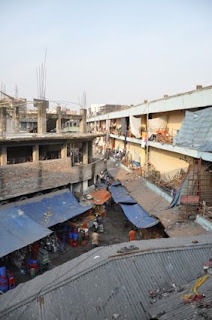
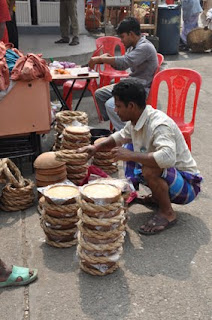
A mad cng rickshaw journey gave little time for reflection about Dhaka, I had arrived 26 days ago as the city was preparing for the dark. The journey in log jammed traffic had taken 2hrs, this morning as the haze of pollution still lingers like a morning mist, it takes only half an hour. When we had arrived at the airport nearly a month ago, we had heard the evening call to prayer – I leave now in the dawn, as the city starts to move. Things in Dhaka don’t seem to stop, people sweep the dust in the streets left by the construction lorries, spinning it up in the air only for it to descend somewhere else. One thing that I will not miss about Dhaka is the thin grey film of dust which falls silently and coats everything – the bath, the sink, clothes, the floor. Whilst the pollution is bad here, Bangladesh has taken bigger steps than some; plastic bags are banned and natural gas powered vehicles are much more common than in the UK, all rickshaws in the cities are CNG powered.
The journey to the airport was relatively quiet, just the occassional horn, a thing I will not miss is the constancy of their noise here too.
Some of the sounds were amazing to hear, experiencing a city wake with the ripples of song, the men calling for alms on a Friday, the musical rhythm of the metalworkers hammering, the tinkle of the rickshaw bells. Bangladesh gets into all of your senses.
Dhaka - Delhi, Dehli - Mumbai, Mumbai - Ahmedabad.

We fly out over the top of the National Assembly Building, the Jatiyo Sangsad Bhaban and head out to roughly follow the line of the river Ganges, passing between Patna and Varanasi with a glimpse of Kathmandu and the Himalayas peaking through the clouds in the distance.

The Ganges river had been used by the East India Company as a main trade route for shipping goods from across India to the coast via Kolkata (Calcutta), and then out into the Bay of Bengal and off to markets across the seas. For Hindus the Ganges is the holiest of all rivers. It is central to the history of the Indian subcontinent.
"The Ganges, above all is the river of India, which has held India's heart captive and drawn uncounted millions to her banks since the dawn of history. The story of the Ganges, from her source to the sea, from old times to new, is the story of India's civilization and culture, of the rise and fall of empires, of great and proud cities, of adventures of man…". Nehru: 'The Discovery of India'.
As the plane moves towards Dehli, the land below becomes a patchwork of fields.

Near Mumbai there are stunning mountains.


 I liked the patterns, lines and markings on the runways.

 It feels odd, now, sitting at Mumbai airport, waiting for my third flight of the day to Ahmedabad, I am surrounded by tourists of all ages and origins. Having spent the last 26 days seeing only approximately 10 other ‘white’ westerners and at times feeling like the oddity, its feels comforting to be able to disappear and blend into the background. Britto have helped us to see beyond the tourist and to get inside a tiny bit of Bangladesh, to see the exciting and culturally intense aspects of that country, to see the things that make them as artists 'tick' to see the things and share what inspires.
I liked the vinyl drawings on the walls in the airport at Mumbai, even though some bits were missing.

I land in Ahmedabad, Gujarat and I'm met by 'Jonny' owner of Ahmedabad Travel, a tour guide company and friend of Arts Reverie. He takes me to Dhal ne Pol, he talks of the mad traffic and how busy and hectic it is on the roads. We pass several of the cities gates. I feel overwhelmed by the idea of further visual and cultural stimulas. The roads seem relatively calm and empty compared to Dhaka. I'm in India!