Making Space:Sensing Place

In October 2009, along with artist Thurle Wright, I was awarded a Making Space:Sensing Place Fellowship; part of the HAT: Here and There International Exchange Programme, managed by A Fine Line:Cultural Practice. The Fellowship includes residencies with Britto Arts in Dhaka, Bangladesh, with Arts Reverie in Ahmedabad, Gujarat, with The V&A Museum of Childhood, Bethnal Green, London and with The Harley Gallery, Nottinghamshire. Working and collaborating with artists and craftspeople from the UK, Bangladesh and India, responding to the collections and spaces we encounter and sharing these experiences through a touring exhibition and educational workshops.

This blog, which is still developing and being added to, is a record of my experiences during the MS:SP Fellowship. Steven Follen.
www.stevenfollen.com

Showing posts with label Landscape. Show all posts

Saturday, 12 February 2011

India Future of Change

Some of the MS:SP Fellowship photos from India have been included in the 'India Future of Change' photographic competition.
You can see them on the flicker site here: India Future of Change.

Friday, 12 March 2010

Mandvi Palace and Beach

LOkesh took us to an interesting palace close to Mandvi, known as the Vijay Vilas Summer Palace. 
Built in the 1920's it was the summer palace of His Highness Maharao Vijay Singhji, who ruled over Kutch in the 1940s.  


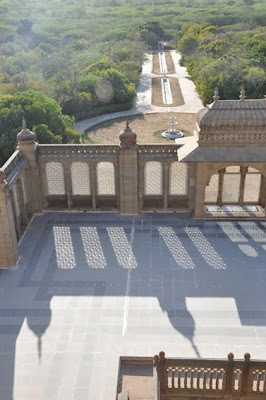
The building is of carved sandstone and is a mix of architectural styles including stunning Bengal domes, Mughal styled cupolas, Rajasthan inspired jarokhas and cusp-arches along with gothic and classical columns.
Towards the top of the building there were beautiful open terraces framed by perforated screens providing privacy yet allowing views across the lush and green estate in which the palace is set. The greenery was a refreshing contrast to the dust of the Kutch desert.
The screens, providing some shade, set shadows across the floor.


Screens and stained glass panels continued the play with light through the interior of the building. 


My favourite part was at the very top of the building. A large domed terrace with beautiful columns, reminiscent of the intricate Jain carving on the temples and mosques in Ahmedabad, provided both shade, a cooling sea breeze and an open space to take in the extensive views of the estate and the Arabian Sea. 

The Royal Family now live at the house permanently and you are able to see parts of the interior, the house contains, photographs and artefacts belonging to the family. 


The building is set in beautiful and tranquil grounds with water channels and marble fountains which would instantly put you at ease.  


I hope the Gheko behaves itself.
The Palace has its own private beach, a secluded and stunning spot, perfect for doing nothing. 

Further along the coast camels take families on the Indian equivalent of a donkey ride at Blackpool beach.
The camels, like the ones we had seen on our trip to Patan have decorative markings, to beautify and help the owners identify their animal.


Wednesday, 10 March 2010

More Bricks

On the way to Modhera we stopped to photograph a group of Hanuman or Langur Monkeys we had spotted in the trees alongside the road.

In a field beyond we saw a family making bricks.
Whilst the process of making the bricks was essentially the same, the scale, pace of production and firing method was different to that which I had seen in Bangladesh.
 Making Bricks.


The method of firing the bricks was similar to the process employed to fire pots in Bangladesh where by a large stack of bricks is made and a fire built around and under them.

Pyramid building.