Making Space:Sensing Place

In October 2009, along with artist Thurle Wright, I was awarded a Making Space:Sensing Place Fellowship; part of the HAT: Here and There International Exchange Programme, managed by A Fine Line:Cultural Practice. The Fellowship includes residencies with Britto Arts in Dhaka, Bangladesh, with Arts Reverie in Ahmedabad, Gujarat, with The V&A Museum of Childhood, Bethnal Green, London and with The Harley Gallery, Nottinghamshire. Working and collaborating with artists and craftspeople from the UK, Bangladesh and India, responding to the collections and spaces we encounter and sharing these experiences through a touring exhibition and educational workshops.

This blog, which is still developing and being added to, is a record of my experiences during the MS:SP Fellowship. Steven Follen.
www.stevenfollen.com

Monday, 29 March 2010

Shiny Metal

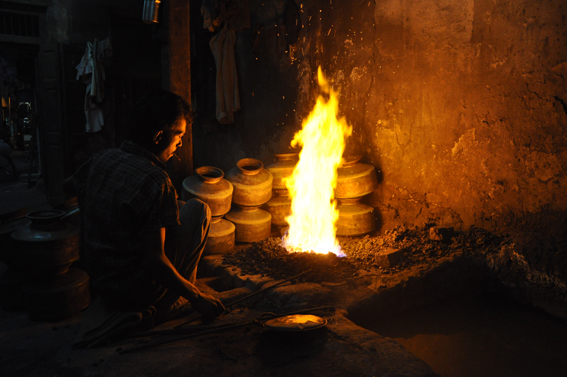
I had seen more of the water vessels around the old town, shiny brass and copper. I decided to revisit the coppersmiths I had met earlier in the month, I wanted to see more of what they did and observe their techniques in more detail. There was a big language barrier but it was a pleasure to sit and watch the skill and directness of their work, the scale of what they make.


Once constructed the vessels are cleaned, under the board a large pit filled with sulphuric pickle is used to clean the oxide from the pots.
A combination of pumice and diluted cow excrement is used to clean the pots and give them a surface ready for planishing.
 When cleaned, the pots are then taken across to another workshop to be planished, to work harden the copper and texture the surface.

Saturday, 27 March 2010

Elephants

Across the river from the City Museum and the Tagore Memorial Hall is an area known as Jamalpur, its close to the old calico mills and there are large fruit and flower markets here which I had passed through many times before in a rickshaw.
I decided to walk back to Arts Reverie from the museum over Sandar Bridge and through Jamalpur. I had been told the elephants which I had seen around the city, crossing Ellis Bridge, eating greens in Manek Chowk, and collecting alms in Gandhi Road were housed in this area, near the Jagdush Mandir, and I thought I would take a closer look on my route back to Dhal ne Pol.

I had once seen an exhibition of Henry Moores drawings of an elephants skull at the Towner Art Gallery in Eastbourne and been struck both by the scale and the complexity of the form of the skull.


The elephants were trully amazing..... and inquisitive! I was great to be so close to such wonderful and huge beasts. Many were old, with pigment loss on their trunks.


It was the end of the day and they were being settled down for the night, their 'saddles' were stacked against the wall of a building.
On the way home I passed Jamalpur Gate or 'Darwaja', one of the many gates which once allowed passage beyond the walled city.
The walls of the city, built in the late 1400's, have now all but disappeared. Those gates which remain are now often small islands of calmness and history caught in the middle of the busy traffic which passes around the ring road to the city. Its interesting that both Dhaka and Ahmedabad have growing voices calling for the protection of their architectural heritage. The Pols and Haveli's in Ahmedabad and the colonial houses and city gateways in Old Dhaka.

Tagore Memorial Hall - Ahmedabad


I had seen the outside of the Tagore Memorial Hall during my first few days in Ahmedabad and had been meaning to return for a more detailed look. The building is quiet amazing, the hall is situated on the bank of the Subarmati River in the City of Ahmedabad, very close to the National Institute of Design and the Ahmedabad City Museum. As a theatre it seats 750 and was built in 1971 from cast concrete, the structure is a series of reinforced concrete frames.The building was designed by the architect Balkrishna Doshi. The hall is named in memory of Rabindranath Tagore a famous Bengali poet, novelist, musician, painter and playwright, who helped shape both Indian and Bengali culture. He was a vocal critic of the British Raj, a supporter of Independence and had penned both the Indian and Bangladesh national anthems.


I like the way the interior structure carries through the 'skin' and out to the exterior of the building.
The transition of the forms in the columns was very beautiful, as was the scale and light.

Like Khans Institute of management building and the architecture of the old city everywhere there were views with multiple layered frames.